
Okay, so check this out—I've been noodling on blockchain explorers for years, and Solana's tooling keeps surprising me. Wow! At first glance a block explorer looks simple: transactions, addresses, tokens. But there's more under the hood, and that complexity is where good explorers either shine or fall flat. My instinct said "this will be straightforward," and then the ledger smacked me with microsecond trades and parallelized transaction patterns that make you rethink what "real-time" even means.
Really? Yeah. Solana's throughput and parallelization change the rules. Short transactions happen in bursts. Medium-size batched actions collide with mempool timing. And long, threaded interactions—like multisig workflows or cross-program invocations—reveal patterns only after you stitch many on-chain events together, which is a pain if your explorer doesn't help. Initially I thought a simple UI and fast search were enough, but then I realized I needed granular program traces, decoded instruction views, and time-sequenced logs to make sense of behavior.
Here's the thing. Explorers are tools for humans and for machines. Hmm... my first impression was that Solscan nails the "human" side—clear UI, token pages, transaction histo—yet it also offers API endpoints that teams use to build data layers. Whoa! That dual role is rare. On one hand, casual users want obvious things: token transfers and balances. On the other, builders and analysts need telemetry, program-level decoding, and reliable historical data. Those requirements sometimes conflict, and the best platforms make trade-offs visible and usable.
I'm biased, but transparency matters. Somethin' about an explorer that hides program logs bugs me. Seriously? When you can't see the inner instruction set, you're left guessing. My experience with live debugging on Solana showed me that the difference between spotting a failed CPI (cross-program invocation) and missing it entirely often comes down to one decoded log line. Actually, wait—let me rephrase that: it's the difference between fixing a bug in an hour and chasing ghosts for days.
On the analytics side, patterns emerge. Short signals like sudden token mints or liquidity shifts are often precursors to larger events. Medium trends—sustained staking changes, wallet clustering—tell stories about user behavior. And long-duration events, such as protocol upgrades or program migrations, reshape the topology of the ecosystem slowly but profoundly. I want my explorer to surface all three.
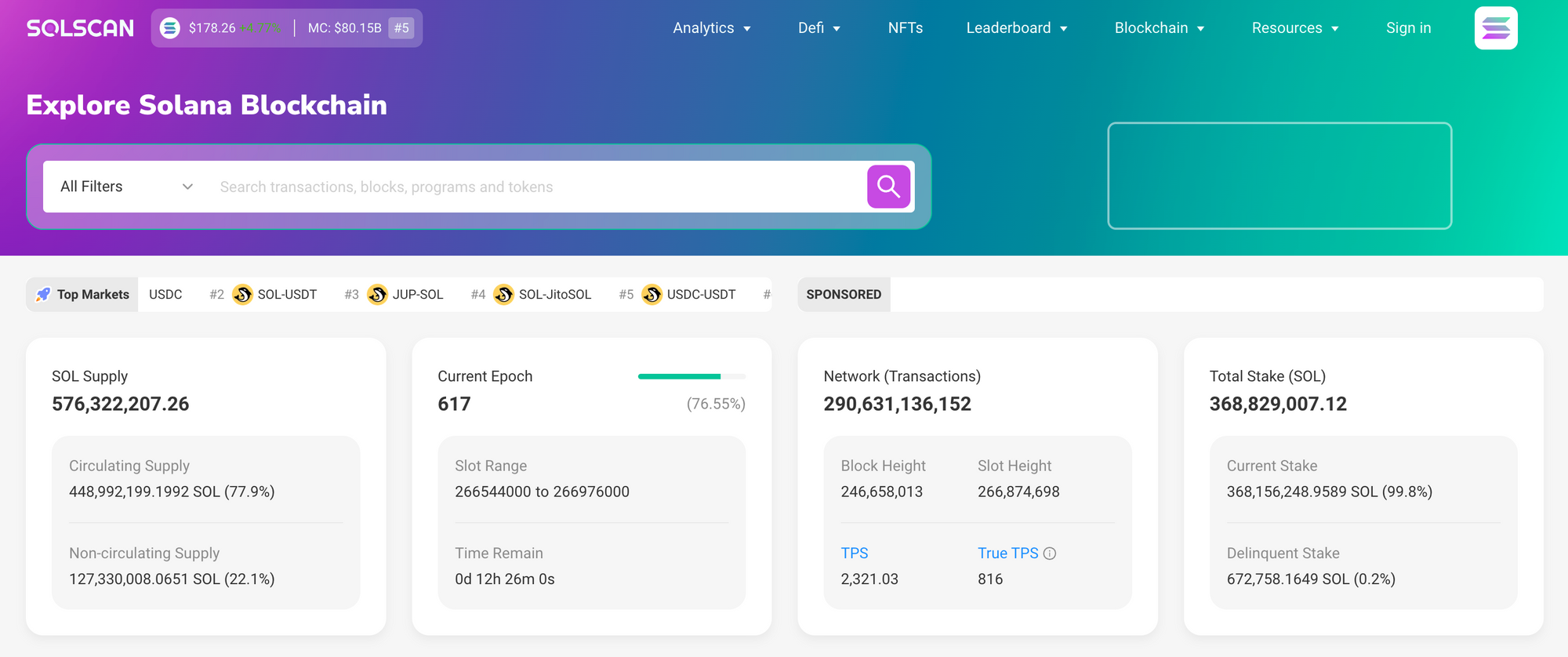
Why Solscan Feels Like a Practical Choice for Everyday and Power Users (solscan explorer official site)
Wow! To start, Solscan hits the sweet spot between usability and depth. Medium users—traders, collectors, curious holders—appreciate the clean token pages and address histories. Long-time developers appreciate program decoding, RPC-friendly endpoints, and detailed instruction breakdowns that let them reconstruct behavior without running a full validator locally. On one hand the UI is approachable; on the other it's also served up with APIs and CSV export options for heavy lifting. I'm not 100% sure about every backend choice they made, but the product decisions show a clear understanding of both audiences.
There's a trade-off though. Big data infrastructure costs real money, and the folks who run explorers juggle uptime, indexer refresh rates, and the inevitable edge-case bugs. Hmm... sometimes the freshest blocks take a beat to index, which can be inconvenient during fast market moves. My gut feeling said that indexing will always lag slightly behind the cluster, and that turned out true in a few high-load tests I've run. Still, the overall responsiveness is solid and the decoded views are often more usable than raw logs.
Here's what bugs me about some explorer experiences: inconsistent instruction decoding across program versions. Really? Programs evolve, and if an explorer doesn't map older instruction layouts, historical analysis breaks. Solscan generally keeps up, but there are moments—edge-case program updates—where traces need manual reconciliation. On the flip side, when they decode properly, you can trace tokens through swaps, AMM pools, and bridge interactions with surprising clarity. That clarity shortens the detective work.
In practice, troubleshooting on Solana often follows a pattern: reproduce the transaction, capture the logs, decode the instructions, and then map state changes. Short sanity checks show wallet balances. Medium checks reveal program calls. Long-form checks—where you reconstruct multi-step flows—require durable logs and searchable archives. My workflow relies on an explorer that makes these steps frictionless. Solscan does most of them well enough that I don't have to spin up local tools every time.
Initially I thought block explorers were mostly read-only windows. But then I started using APIs for automated monitoring. Actually, wait—let me be precise: automated monitoring and alerting are where explorers transform from passive viewers into active guardians. You can set up scripts to watch program accounts, token mints, or liquidity pools, and trigger alerts for anomalous behavior. That shift—turning a UI into an operational service—is underrated, and it's why explorer APIs matter just as much as the web interface.
My instinct also flagged ecosystem trust as a major dimension. People often ask: can I rely on a third-party explorer's data? Short answer: trust, but verify. Longer answer: use the explorer for triage, but cross-check critical data against RPC nodes or your own indexer when stakes are high. I'm not saying Solscan is inaccurate—far from it—but redundancy matters, especially for custodial or compliance-sensitive operations. On that note, archival access and export options become invaluable.
Okay, so check this out—one practical example. I once investigated a token rug suspicion. Whoa! The initial transfers looked like liquidity redistribution. Medium-level digging into historical token mints revealed an unexpected program call that minted tokens off-chain or through a backdoor. My instinct said "bad actor." After deeper trace decoding I confirmed a hidden CPI that created supply outside normal mint authority. Had the explorer not exposed that CPI chain, we might've missed it. Lessons learned: decoded CPIs and historical instruction logs are non-negotiable for security work.
There's also the analytics layer. Long-tail metrics like wallet clustering, token distribution charts, and concentrated holder ratios help contextualize raw events. Medium-sized dashboards can show velocity, while longer trend analysis reveals protocol health. I use these sorts of visualizations to guide risk assessments and to prioritize follow-ups. Solscan's charts aren't a full business intelligence suite—nor should they be—but they provide a useful starting point and export-friendly data for custom analysis.
On developer ergonomics, API stability is king. Somethin' about breaking endpoints mid-quarter makes integrators very very unhappy. Solscan has maintained a relatively stable surface, but there have been breaking changes historically that required migrations. That's normal in startups, though, and their communication has improved. I appreciate changelogs and clear deprecation windows. Initially I thought community-run explorers couldn't keep up with core protocol evolution, but they often adapt faster than expected because they live in the ecosystem day-to-day.
Common Questions I Get
How do explorers differ from full-node analytics?
Short: explorers are indexed and curated views, while full nodes provide raw state. Medium: explorers index and decode transactions for usability and searchability. Long: full nodes let you validate from genesis and reconstruct state exactly, but explorers save time and effort for most operational needs, although they should be cross-checked for critical audits.
Is Solscan reliable for forensic analysis?
Whoa! For initial triage and forensic signals, yes—it's very handy. Longer probes should incorporate raw RPC logs or validator data, but Solscan's decoded instructions and transaction timelines are often enough to identify suspicious patterns and to guide deeper investigations.
Should projects rely on a single explorer for status pages?
Really? Probably not. Use an explorer for human-facing status but pair it with direct RPC health checks and your own alerting daemon for redundancy. I'm biased, but redundancy reduces surprise and operational risk.
Okay, wrapping up my arc here—I'm curious and cautiously optimistic. Initially I felt explorers were just convenience tools, but after digging into Solana's concurrency model and watching live incidents, I see them as essential infrastructure for both users and builders. Hmm... That shift changed how I architect monitoring and incident response.
I'll be honest: no single explorer is perfect. There are trade-offs in index speed, retention, and decode accuracy. My instinct says diversify your tooling and automate cross-checks. Somethin' like using Solscan for quick human reads and supplementing with RPC pulls and a lightweight local indexer for high-value flows works well. It isn't glamorous, but it's practical and it saves time when things go sideways.
Here's the final thought—maybe obvious, maybe not: as Solana evolves, so will the explorers. On one hand we want slick UX and accessible analytics. On the other, we need rigorous, machine-readable data and stable APIs. Balancing those needs is hard, but it's the future of trustworthy infrastructure. I'm not 100% sure what the future UI will look like, though I hope it keeps the blend of transparency and pragmatism we've been getting. Trails of logs, decoded CPIs, and exportable datasets—those are the basics that make explorers worth trusting.